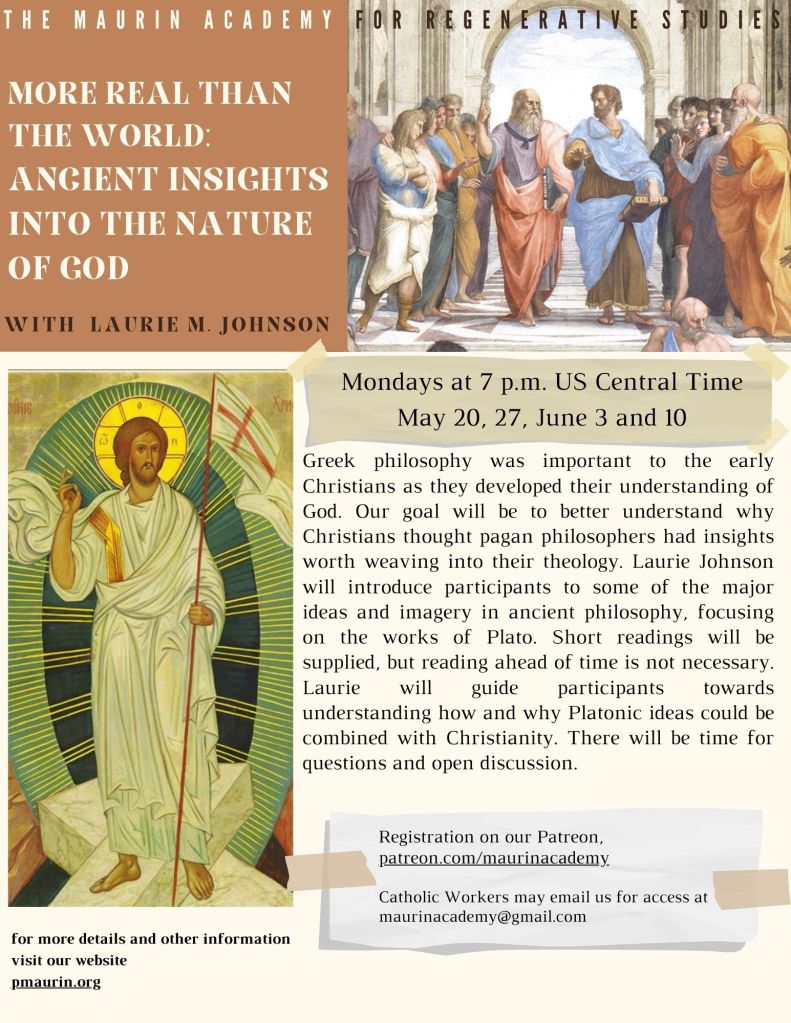
Using selections of texts from Plato’s The Republic, Gorgias, Symposium, and the Laws, Laurie will discuss key ideas that attracted early Christians: Plato’s idealism (doctrine of the forms), his views on justice, the role of human love, the existence of God, and the afterlife. Each session will run roughly 1.5 hours.
May 20: Platonic idealism and the relationship between the intelligible and the material world. This week, we’ll discuss why and how Plato departed from/critiqued Greek polytheism, and how he developed his distinction and relationship between the material world of change and the eternal realm of ideas and forms. Core text: Republic.
May 27: Plato on human nature and the distinction between true justice and conventional justice. Plato thought that human justice was often very lacking because those who defined it did not understand eternal justice. This week we’ll discuss the relationship between all-too-human actions and laws and true justice, and why understanding this relationship is important for moral reasoning. Core text: Republic.
June 3: The ladder love: how human affection is a (pale) reflection and indication of divine love. Understanding the true meaning of “Platonic love” will help us understand the relationship between our imperfect earthly existence and the eternal logos or reason that Plato thought human beings could grasp via philosophy. Core text: Symposium.
June 10: Proofs of God’s existence and the eternality of the human soul. Plato argued that it made logical sense to believe in one God, so this week we will examine one of his arguments. We will also learn something of his unconventional views of humanity’s place in the afterlife, and sum up what all of this has to do with the development of Christian theology. Core texts: Laws, Gorgias.
 Political Philosophy