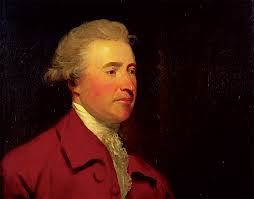
Edmund Burke’s Noble Lie (Reflections 3)

After defending the English Revolution of 1688 as a thing of a different and more respectable sort than the French Revolution of 1789, Burke goes on to argue against universal rights in favor of the particular rights of particular people. He believes that people receive their rights through inheritance from past practice, and that the … More Edmund Burke’s Noble Lie (Reflections 3)

Edmund Burke: Is Revolution Ever OK? (Reflections 2)

The first part of Edmund Burke’s Reflections on the Revolution of France takes on England’s Revolution Society and Rev. Richard Price, whom Burke considered a dangerous and radical agitator. We begin to see that Burke does not like mixing religion and politics, and he dislikes politics practiced with religious zeal. He argues that there is a big difference between the Glorious Revolution in England in 1688 and the French Revolution of 1789. Is he right? … More Edmund Burke: Is Revolution Ever OK? (Reflections 2)

Introduction to Edmund Burke and Reflections on the Revolution in France

Why read Edmund Burke? In this introduction I explain that his classical conservatism is more of a way of thinking than it is an ideology, and as such it is flexible. It is also practical, and we need more of that in a time in which too many waste their efforts in theorizing for its own sake (or worse) just attacking the “other side.” … More Introduction to Edmund Burke and Reflections on the Revolution in France

Dissenting Christianity–Here’s Where to Start

A list of resources is below. After reading Walter Brueggemann’s Out of Babylon, it’s only logical to ask “so where would I go to get this type of Christianity?” I’ve put together my own personal shortlist of resources to help anyone who wants to “dip their toe into these waters” as to where to turn … More Dissenting Christianity–Here’s Where to Start

12 Step Program for Christians Addicted to Empire (Out of Babylon 6 audio)

ve all 12 steps, but it does give us at least two steps, and a “serenity prayer” for our particular addiction. In this penultimate episode dealing with Walter Brueggemann’s Out of Babylon I discuss the themes that emerge in the last chapter dealing with accommodation and resistance to empire. Brueggemann is unflinching in his warning to US Christians that they have verged from accommodation, which is sometimes necessary, to capitulation, which is inexcusable and amounts to idolatry and rejection of “local identity” or strong community values. … More 12 Step Program for Christians Addicted to Empire (Out of Babylon 6 audio)

Christian Nationalism as Stockholm syndrome (Brueggemann 5)

Christian nationalism–the reasons it is wrong but also the possible reasons why it exists. Looking at the Old Testament as a source of iconic, archetypal and enduring truths is discussed as an alternative to the narrative of the US as the new Israel. If people remain captive to Empire, why? Is it partly because they truly have been displaced and are tempted by cooptation? Is it due to their fear of the wilderness and the freedom it represents? … More Christian Nationalism as Stockholm syndrome (Brueggemann 5)

Divine Imagination & Futuring (Brueggemann: Out of Babylon 4)

Chapter 4 of Walter Brueggemann’s Out of Babylon discusses the power of poetic imagination to create the conditions for change. Multiple views of God’s position relative to humans, and the human response to God are entertained in poetic language. Brueggemann emphasizes the latter as a strength that shows a way beyond the sectarian infighting that characterizes most religious sects and keeps those within them from being able to act positively to create a better future. The idea of a mutable God is discussed–a God who is able to change his mood and mind in response to changes in relationship to his human fold. In dealing with this kind of God, having a fertile imagination about the future is particularly important, as it fosters hope and cancels despair that tends to occur as people bow down to imperial economics and politics. … More Divine Imagination & Futuring (Brueggemann: Out of Babylon 4)

Against the Ideology of Certainty Besetting US Christians (Out of Babylon 3)

God’s will with the will of the nation and resolve morality into the aims of national power, or to choose the “local tradition” of adherence to God’s priorities even when they clash with the priorities and values of empire. The latter involves first recognizing that there is a necessary and unresolvable conflict between any national will and Judeo-Christian morality. Brueggemann asks, will the Christian church be a national church or will it be governed only by God? … More Against the Ideology of Certainty Besetting US Christians (Out of Babylon 3)

The Price of Hypocrisy (Out of Babylon: Brueggemann 2) ft. Nietzsche

the second chapter of Walter Brueggemann’s book Out of Babylon, the “local tradition” of the United States, as the “shining city on a hill,” is explored in the context of prophetic calls for examination and repentance both in the Old Testament and in Walter Brueggemann’s theology. People always design narratives to explain their situation and role in the world, and Brueggemann teaches that this is not only inevitable but good–or it can be, if the story we tell is not simply delusion but pushes us to act in according to the values we say we embrace. In this case, he’s talking about Biblical Christian values and he is asking American Christians what (or who) they really stand for. I think this is a very worthy question, so this session is devoted to it. … More The Price of Hypocrisy (Out of Babylon: Brueggemann 2) ft. Nietzsche

Empire and God: Do They Mix? (Out of Babylon, Brueggemann 1)

discussing Brueggemann’s view that US Christians who hew to the “City on the Hill” ideology are committing idolatry and are aligning with Empire and not with God, the two being ultimately opposed. This is not to establish a mere negative argument (as in, this is what a Christian is not), but rather to begin to point to a positive pronouncement (this is what a Christian or other person faithful to God is) . … More Empire and God: Do They Mix? (Out of Babylon, Brueggemann 1)